International Law in Asia Today is a new blog series launched by AsianSIL Voices to highlight historical events that mark Asia’s engagement with international law. Each post revisits a specific date to make international legal history in Asia more visible and accessible to a wider audience.
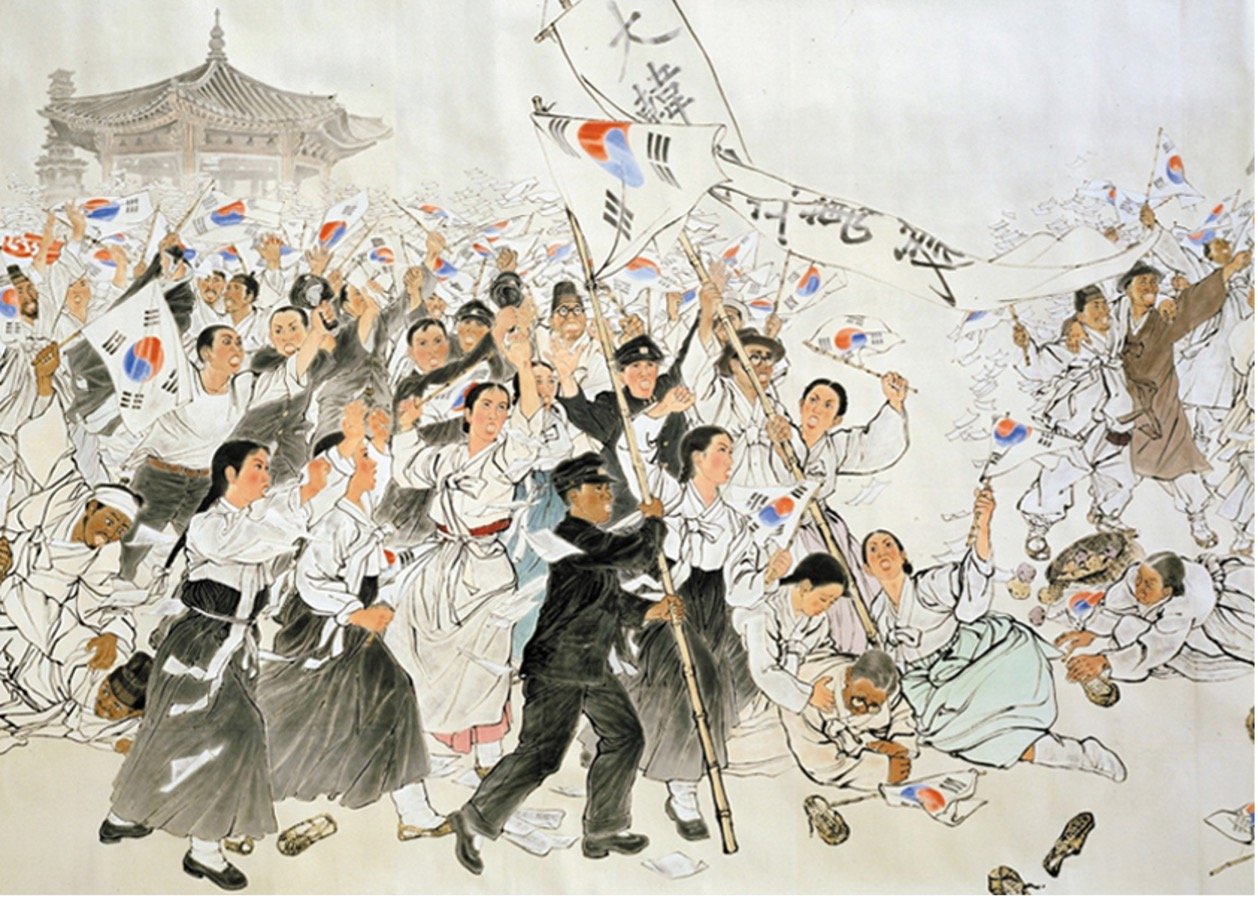
The March First Movement – A Trailblazer for Self-Determination
It is perhaps not hyperbole to assert that one of the most consequential events in the history of the Republic of Korea is the March First Movement (the “Movement”), or Samiljeol. Widely recognised as a paradigmatic example of non-violent struggle against foreign rule, the Movement championed for Korea’s independence from Japanese occupation, inspired partly by the emergence of the principle of self-determination following World War I. This article examines how the then-nascent principle of self-determination catalysed the Movement and the subsequent Claim for Korean Independence (the “Claim”), and argues that the Claim sought to invoke an interpretation of the concept of self-determination that would only evolve much later.
The March First Movement
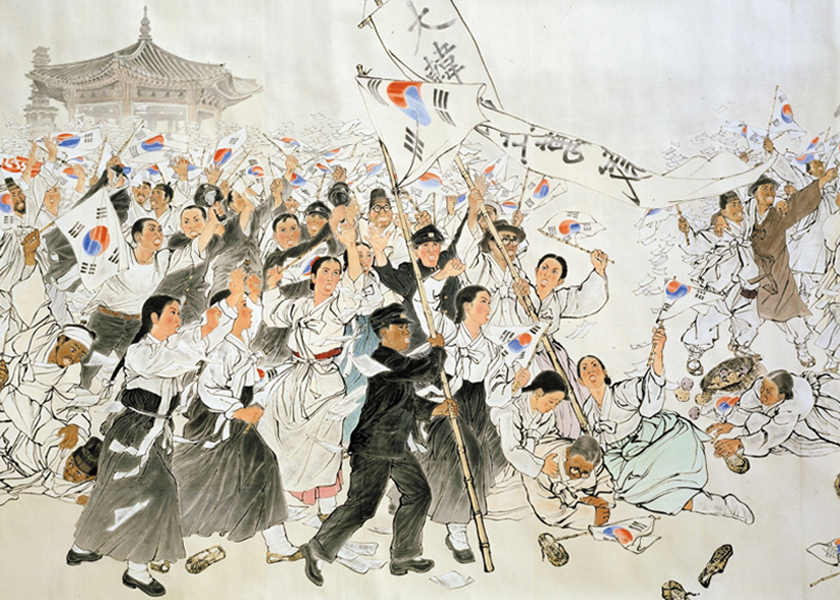
In 1910, Japan formally annexed Korea with the signing of the Treaty of Annexation, which marked the start of 35 years of imperial rule until Japan surrendered in 1945, following its defeat at the end of World War II. This period of Japanese occupation, characterised by strict military rule and the brutal suppression of Korean culture and identity, was met with unwavering resistance culminating in a series of peaceful protests. On 1 March 1919, the 33 national representatives of the Movement announced the Declaration of Korean Independence, kickstarting independence campaigns throughout Korea. Although the Movement ultimately failed to achieve Korean independence and resulted in thousands being killed, wounded and arrested by Japanese police and soldiers, it nonetheless played an instrumental role in Korea’s struggle for liberation. Today, the significance of this event is underscored by its inclusion in the Constitution of the Republic of Korea, which seeks to uphold the cause “born of the March First Independence Movement of 1919”. Moreover, March First continues to be celebrated as a national holiday in both North and South Korea.
A Catalyst for the Movement – The Emerging Principle of Self-Determination
While the Movement was surely spurred on by internal factors including the death of the pro-independence Korean Emperor Gojong, whose controversial death was speculated to have been caused by the Japanese, external influences cannot be discounted. In particular, the ideas of national self-determination alluded to by American President Woodrow Wilson in his famous 1918 Fourteen Points speech proved to be a major catalyst for the Movement and contributed to the subsequent push for Korean independence. Though President Wilson did not explicitly invoke the term “self-determination” then, some of the points articulated would go on to become core tenets of the concept. For example, the fifth point in Wilson’s speech was that in all questions of sovereignty, the interests of the populations concerned must be considered – arguably, this is an early iteration of the requirement that the exercise of the right to self-determination be “a free and genuine expression of the will of the peoples concerned”, as affirmed by the ICJ in its 1975 Advisory Opinion on Western Sahara.
The impact of President Wilson’s speech on Korean independence can be further observed in the Claim submitted to the Paris Peace Conference by the newly constituted Korean Provisional Government in April 1919, approximately a month after the commencement of the Movement. The Claim directly referenced President Wilson’s Fourteen Points speech, emphasising in particular the principle that all peoples and nationalities have a right to “live on equal terms of liberty and safety with one another, whether they be strong or weak”.
Though President Wilson is often credited with inspiring claims of national self-determination, it is highly contested whether he intended it to be a right to self-determination for colonial peoples generally. The answer appears to be in the negative – had it been a recognition of a claim for self-determination for all colonial peoples, it would also have meant the recognition of self-determination to the colonial peoples of the United States and its Allies, which had never been the intention; indeed, President Wilson later clarified that the Paris Peace Conference could not “act upon the right of self-determination of any peoples except those which had been included in the territories of defeated empires.” Thus, as Hannum posited, this initial phase of self-determination “required the support of the victorious powers if there had been a war” and was Euro-centric in nature, thereby precluding its application to colonial empires. Rightly interpreted, it would thus have precluded Korea’s claim to independence from Japan.
Situating the Claim within the Evolution of the Concept of Self-Determination
Yet in referencing President Wilson’s Fourteen Points speech and the implicit concept of self-determination, the 1919 Claim sought to broaden the contours of the concept, and is arguably much ahead of its time in invoking certain ideas of self-determination that would not develop until the second half of the 20th century.
To briefly trace the evolution of the concept of self-determination, it was first a political principle popularised as a result of the “Wilsonian movement”. As such, self-determination was subject to political concerns and dependent on major powers. While the adoption of the United Nations Charter at the end of World War II sought to recognise the “self-determination of peoples” under Article 1(2) as a legal principle for the first time, its inclusion was really only a recognition of the independence of the members of the United Nations and was intended as nothing more than a recognition of the principle of state sovereignty.
It was only in 1960, with the adoption of resolution 1514 (XV), that the principle of self-determination shifted to a right capable of being exercised by colonised peoples. Though it is a non-binding General Assembly resolution, the ICJ has characterised it as having a “declaratory character with regard to the right to self-determination as a customary norm”. Thus, when the Korean Provisional Government submitted the Claim back in 1919, it was appealing to the right of colonial peoples’ to be independent from their colonial power – a right which would not be recognised until almost half a century later. The 1919 Claim could thus be said to be an early exhortation for the concept of self-determination to encompass independence for colonial territories.
Conclusion
Even though nascent notions of self-determination may have triggered the start of the Korean independence movement, self-determination did not directly achieve Korean independence; it was Japan’s surrender in the Pacific War which eventually granted independence to Korea. Notwithstanding this, the Movement remains an important aspect of Korea’s struggle for independence, and would proceed to inspire other non-violent struggles for the liberation of colonised peoples within the Asia region.
Author
Huang Hung Yu is an LLB student at the National University of Singapore.
Image Source: https://www.koreanquarterly.org/wp-content/uploads/2020/06/MarchFirst_2.jpg