International Law in Asia Today is a new blog series launched by AsianSIL Voices to highlight historical events that mark Asia’s engagement with international law. Each post revisits a specific date to make international legal history in Asia more visible and accessible to a wider audience.
This Day in History
On 6 November 2007, the International Court of Justice (ICJ, the Court) opened public hearings in the case concerning Sovereignty over Pedra Branca/Pulau Batu Puteh, Middle Rocks and South Ledge (Malaysia/Singapore). The case was submitted to the ICJ under a Special Agreement, which had been signed by the two governments in 2003. In this agreement, the Parties requested the Court to determine sovereignty over the three maritime features.
Geographical Context
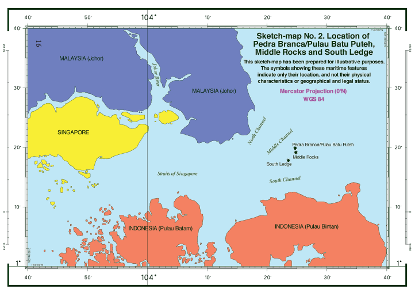
Pedra Branca is a small granite island located at the eastern entrance of the Singapore Strait. It measures about 137 metres in length and 60 metres in width, with a total area of roughly 8,560 square metres at low tide. The island lies approximately 24 nautical miles east of Singapore, 7.7 nautical miles south of the Malaysian State of Johor, and 7.6 nautical miles north of Indonesia’s Bintan Island. Its name, “Pedra Branca” in Portuguese and “Batu Puteh” in Malay, means “white rock.” On the island stands Horsburgh Lighthouse, which was constructed in the mid-nineteenth century. Close to Pedra Branca are two other features: Middle Rocks, a small formation permanently above water about 0.6 nautical miles to the south of Pedra Branca, and South Ledge, a low-tide elevation located about 2.2 nautical miles to the south-south-west. (See para.16-18, ICJ Judgment on Pedra Branca)
Historical Context
After Singapore gained independence in 1965, it continued to maintain and administer Horsburgh Lighthouse on Pedra Branca. Malaysia, however, claimed that Pedra Branca, together with Middle Rocks and South Ledge, had historically been under the sovereignty of the Sultanate of Johor. Malaysia argued that earlier colonial arrangements, including the 1824 Anglo-Dutch Treaty and the Crawfurd Treaty, which ceded Singapore and its surrounding islets within 10 miles to the British but left Pedra Branca outside this cession, confirmed Johor’s original title. In its view, the construction of the lighthouse in 1850-1851 did not extinguish Johor’s sovereignty. (See para.20-29, ICJ Judgment on Pedra Branca)
The dispute crystallized in 1979, when Malaysia published a new map depicting Pedra Branca within its territorial waters, prompting an immediate protest from Singapore. Diplomatic exchanges followed for several years. On 6 February 2003, the two governments signed a Special Agreement, which entered into force on 9 May 2003, jointly seising the ICJ of the matter. Under the terms of that Agreement, Malaysia and Singapore requested the Court to determine sovereignty over Pedra Branca, Middle Rocks and South Ledge, and undertook in advance to accept the Court’s judgment as final and binding. (See para.30-36, ICJ Judgment on Pedra Branca)
Procedural Developments and Hearings
The case was entered onto the ICJ’s General List on 24 July 2003, following the joint notification by Malaysia and Singapore. Written pleadings were exchanged, and the Court held oral hearings from 6 to 23 November 2007. For Malaysia, the delegation included Abdul Kadir Mohamad, Noor Farida Ariffin, Abdul Gani Patail, and counsel Elihu Lauterpacht, James Crawford, Nicolaas Schrijver, Marcelo Kohen, and Penelope Nevill. For Singapore, the delegation included Tommy Koh, S. Jayakumar, Chao Hick Tin, Chan Sek Keong, and counsel Alain Pellet, Ian Brownlie, Rodman Bundy, and Loretta Malintoppi. (See para.1, 10, 12, ICJ Judgment on Pedra Branca)
Legal Arguments
In the written and oral proceedings, Malaysia argued that Pedra Branca had always been part of the State of Johor and that Malaysia, as Johor’s successor, retained original title. According to Malaysia, the island was never terra nullius and thus could not be acquired through occupation. Johor had never ceded, nor abandoned, its sovereignty, and Britain’s construction and maintenance of Horsburgh Lighthouse in the mid-nineteenth century had been carried out with Johor’s permission. In Malaysia’s view, such activities were insufficient to establish sovereignty. (See para. 37-38, ICJ Judgment on Pedra Branca)
Singapore, by contrast, argued that the events of 1847-1851, when the British authorities selected Pedra Branca as the site for Horsburgh Lighthouse, amounted to a lawful taking of possession à titre de souverain. The British Crown thereby acquired title to the island under the international law of the time. Singapore further contended that Britain, and later Singapore itself, continuously and peacefully exercised State authority over Pedra Branca. It characterized the island as terra nullius (or of indeterminate status) before 1847, with no evidence of Johor exercising sovereignty. Singapore therefore rejected Malaysia’s claim of ancient original title. (See para. 39-42, ICJ Judgment on Pedra Branca)
The Judgment and Subsequent Developments
In its judgment of 23 May 2008, the ICJ held that sovereignty over Pedra Branca/Pulau Batu Puteh belongs to Singapore; that sovereignty over Middle Rocks belongs to Malaysia; and that sovereignty over South Ledge belongs to the State in whose territorial waters it is located.
In 2017, Malaysia filed an application for revision of the 2008 judgment, invoking Article 61 of the Statute of the Court, paragraph 1, citing newly discovered documents from the UK National Archives. However, on 28 May 2018, two weeks before the scheduled hearing, Malaysia notified the ICJ of its decision to discontinue the proceedings. On the following day, Singapore confirmed its agreement to the discontinuance, and the Court subsequently recorded the discontinuance of the case concerning (See the Order of ICJ). In 2024, however, Malaysia established a Royal Commission of Inquiry to examine its 2018 decision to withdraw the application for revision of the Pedra Branca judgment. In response, Singapore’s Ministry of Foreign Affairs stated that the inquiry was an internal matter for Malaysia, and recalled that under the ICJ Statute, a judgment cannot be revised once ten years have elapsed from the date of its delivery. Both countries continue to address outstanding issues relating to Pedra Branca through a Joint Technical Committee.
Despite the subsequent developments surrounding the case, the Pedra Branca proceedings remain a demonstration of two neighbouring Asian states choosing to resolve a sensitive territorial dispute through peaceful means. That both Malaysia and Singapore subjected such an issue to judicial settlement before the ICJ underscores their commitment to the rule of law in international relations. Today, in a period marked by increasing geopolitical tensions and uncertainty, looking back at this case serves as a reminder of the role international law can play in peacefully resolving disputes and crises.
Author
HUANG Fan, PhD Candidate, NUS Law; AsianSIL Voices Transitional Associate Editor.
Photo source: ICJ Judgement on the Sovereignty over Pedra Branca/Pulau Batu Puteh, Middle Rocks and South Ledge (Malaysia/Singapore), p.24