International Law in Asia Today is a new blog series launched by AsianSIL Voices to highlight historical events that mark Asia’s engagement with international law. Each post revisits a specific date to make international legal history in Asia more visible and accessible to a wider audience.
21 December 1971: UNSC Resolution 307 and the Limits of Ceasefire Diplomacy along the India-Pakistan border
Introduction to Resolution 307
On 21 December 1971, the United Nations Security Council (UNSC) adopted Resolution 307, demanding a “durable cease-fire and cessation of all hostilities” between India and Pakistan. Adopted in the immediate aftermath of the 1971 India-Pakistan War, the resolution was an attempt by the UNSC to halt further escalation in a volatile subcontinent of South Asia.
Although Resolution 307 is often eclipsed by the creation of Bangladesh, it was critically the last UNSC resolution directly addressing hostilities between India and Pakistan. This article thus examines Resolution 307 and highlights the structural limits of the UNSC’s engagement in deeply politicised interstate conflicts.
India-Pakistan Tensions: Genesis and Colonial Legacies
The conflict addressed by Resolution 307 must be understood with reference to the ramifications of the British colonial rule in the Indian subcontinent. Prior to independence, British India comprised 584 “princely states”, each governed by a ruler, either a Hindu Maharajah or a Muslim Nawab, who was permitted, upon decolonisation, to accede to either India or Pakistan.
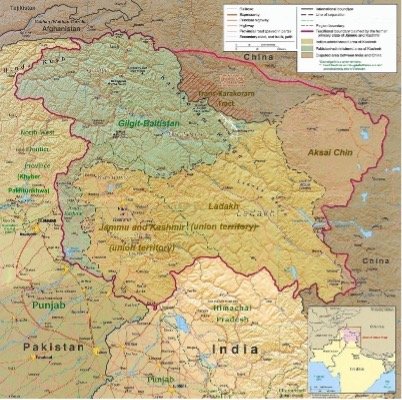
Kashmir, one such princely state, was in territorial contention. Despite having a predominantly Muslim population, it was ruled by a Hindu Maharajah. The Maharajah’s accession to India in 1947 triggered the first India-Pakistan war in 1947, which ended with a UN-brokered ceasefire and the establishment of a ceasefire line monitored by the United Nations Military Observer Group in India and Pakistan (UNMOGIP). The dispute over Kashmir remained unresolved, contributing to renewed hostilities in 1965 and continuing to shape India-Pakistan tensions thereafter.
The 1971 India-Pakistan War
To appreciate the urgency of Resolution 307, it is necessary to distinguish the 1971 India-Pakistan War from the longer-running Kashmir dispute. The 1971 India-Pakistan war was precipitated by an internal political crisis between East and West Pakistan. Following the 1970 Pakistan general election, East Pakistan’s Awami League party won a majority. Yet, the failure of the central government in West Pakistan to transfer power to East Pakistan led to widespread unrest, followed by a military crackdown on Bangladeshi nationalists in March 1971.
The violence sparked the Bangladesh Liberation War, which opposed Pakistani rule in East Pakistan and garnered the support of India. Alongside liberation arose a severe humanitarian crisis, with millions of civilians fleeing into India. As refugee flows and border tensions mounted, India regarded the situation as one implicating regional security. Hostilities escalated into war in early December 1971, following Pakistani air strikes on Indian territory and India’s military intervention on both eastern and western theatres.
While the war concluded swiftly in the eastern theatre with the surrender of Pakistani forces on 16 December 1971 and the emergence of Bangladesh as an independent state, military engagements along the western front persisted. It was this risk of renewed escalation that gave rise to the UNSC’s intervention in the form of Resolution 307.
Resolution 307: Ceasefire Demands and Humanitarian Obligations
Resolution 307 was adopted with 13 votes in favour, with two abstentions from Poland and USSR, reflecting broad consensus in favour of de-escalation despite Cold War divisions.
The resolution had three key elements. Firstly, it demanded a durable ceasefire and cessation of all hostilities in all areas of conflict, and called for the supervision of the ceasefire line in Jammu and Kashmir by the UNMOGIP. Secondly, it emphasised compliance with international humanitarian law, calling upon the parties to observe the Geneva Conventions of 1949, including obligations to protect civilians, prisoners of war, and the wounded. Thirdly, it urged international assistance for refugees and their return to safety. The UNSC thus framed the conflict not merely as an end to military hostilities, but a legal obligation for humanitarian aid.
Simla Agreement: Bilateral or International Diplomacy?
Resolution 307 set the stage for the 1972 Simla Agreement, a peace agreement to foster a “friendly and harmonious relationship” between India and Pakistan. The agreement converted the 1949 ceasefire line into the bilaterally agreed upon “Line of Control” in Jammu and Kashmir and affirmed respect for the UN Charter. Nonetheless, despite such affirmation, India characterised the conflict as a mere bilateral affair not warranting international intervention.
UNSC Involvement: A Pattern of Restraint
The UNMOGIP has remained deployed since 1948, with Resolution 307 reaffirming the UNMOGIP’s supervisory role over the ceasefire line. This makes it one of the UNSC’s longest-standing peacekeeping missions.
However, in practice, the UNMOGIP’s effectiveness has been constrained, where the Kashmir issue has “virtually disappeared” from the UNSC’s agenda. With bloodied incidents, shelling and gunfire on the Line of Control, ceasefire violations continue to occur. In November 2016, then Secretary-General Ban Ki-moon expressed that he was “deeply concerned” about the deteriorating situation along the Line of Control.
Further underscoring the limits of Resolution 307 and UNSC engagement in India–Pakistan tensions are the recent developments in May 2025. The UNSC members convened in closed consultations under the agenda item “The India-Pakistan question” at Pakistan’s request, following a deadly militant attack killing 26 civilians in Pahalgam, Kashmir. These consultations marked the first time since 2019 that the UNSC formally met to discuss the Kashmir dispute. Notably, however, the meeting was held behind closed doors and did not result in any substantive action beyond general calls for “calm and restraint”. Even a subsequent press statement condemning the attack required careful negotiation, with references to the territorial status of Kashmir and attribution of responsibility removed to achieve consensus.
The continued disengagement with the India-Pakistan conflict reflects a pattern of the UNSC restraint, where major powers are unwilling to exert pressure on the parties concerned. Neither the Western powers nor Russia have been prepared to confront India on Kashmir, which India consistently characterises as an “internal” matter, despite calls by Pakistan to the contrary. Such restraint is illustrated similarly in the UNSC Resolution 1172 following 1998 nuclear tests by India and Pakistan, which couched terms in a non-forceful way and did not impose a modus operandi.
Conclusion: Resolution 307 as a Cautionary Tale
More than five decades on, Resolution 307 remains relevant not because it attempts to resolve the India-Pakistan conflict, but because it illustrates how ceasefires can persist in form while eroding in substance. While it demonstrates the UNSC’s capacity to act decisively where humanitarian considerations align with geopolitical interests, it exposes the structural limits of collective security, where any meaningful engagement is curtailed by major-power politics and interstate rife. In this sense, Resolution 307 stands as a cautionary tale in the limits of international law.
Author
Hnin Ei Wut Yee is an LLB student at the National University of Singapore and a Junior Editor at the Singapore Law Review. Her academic interests include Asian legal studies and public international law, and she is pursuing a minor in Southeast Asian Studies and Philosophy.
Photo source: Wikimedia Commons, “Kashmir Region (November 2019)”, CC BY-SA 4.0, https://commons.wikimedia.org/wiki/File:Kashmir_Region_November_2019.jpg