The Ocean’s Constitution: How a 1982 Treaty Redrew the Map of Global Power
This Day in History
On 30 April 1982, the world’s nations came together at the United Nations in New York to adopt the text of the United Nations Convention on the Law of the Sea, or UNCLOS. After nine years of intense negotiations at the Third United Nations Conference on the Law of the Sea (UNCLOS III), this comprehensive treaty —often called the “Constitution of the Oceans”— was finally settled. Though it would take over a decade for the Convention to formally enter into force (in 1994), its adoption on this day set the stage for a revolution in ocean governance, moving away from centuries-old maritime traditions toward a new global order rooted in the sovereignty and economic rights of coastal states. This blog post sets out a brief history of UNCLOS negotiations and some of its key features, especially that of particular relevance to Asian states.
The Evolving Process of the UNCLOS Regime
The journey to the final UNCLOS text was far from simple, marked by a deep ideological split between the industrialized maritime powers and the developing nations, often called the Group of 77. While the major powers sought to preserve the traditional freedom of the high seas and unfettered access for their navies and distant-water fishing fleets, the newly independent states were focused on asserting control over their adjacent coastal resources, which they viewed as essential to their economic sovereignty and development, essentially rejecting the old colonial model of ocean use. This split fueled a long negotiation process, as the emerging nations successfully championed the 200-nautical-mile Exclusive Economic Zone (EEZ) as a core concept.
However, the most contentious issue proved to be the regime governing the mineral resources of the deep seabed, which UNCLOS designated as the “Common Heritage of Mankind.” Key industrialized nations, including the United States, balked at the mandatory technology transfer and production control provisions intended to ensure equitable sharing of benefits with developing countries. Their refusal to sign or ratify the 1982 Convention created a significant hurdle, casting a shadow over the treaty’s universal acceptance and necessitating further negotiation.
This impasse was eventually broken over a decade later with the 1994 Agreement relating to the Implementation of Part XI of the United Nations Convention on the Law of the Sea. This agreement substantially modified the deep seabed mining regime to be more market-oriented and acceptable to the industrialized states. For example, the 1982 text would have required a US-based company, upon receiving a mining contract, to sell its proprietary deep-sea robotic collector technology to the UN’s Enterprise or a developing country, even if the company did not want to sell it; the 1994 Agreement removed this compulsory sales clause, making the transfer of such sensitive technology a matter of negotiation on market terms. This compromise, though weakening the original Common Heritage of Mankind concept, paved the way for most industrialized nations to ratify the Convention, allowing UNCLOS to finally achieve the widespread support necessary to function as the universally accepted legal framework for nearly all aspects of ocean space.
The Role of UNCLOS in Maritime Delimitation
The United Nations Convention on the Law of the Sea (UNCLOS) provides the definitive legal basis for coastal states to establish their maritime zones and to resolve disputes over overlapping claims. Article 74(1) of UNCLOS mandates that the delimitation of the Exclusive Economic Zone (EEZ) between states with opposite or adjacent coasts shall be effected by agreement on the basis of international law, as referred to in Article 38 of the Statute of the International Court of Justice, in order to achieve an equitable solution. Similarly, Article 83(1) governs the delimitation of the continental shelf. This framework, enables post-colonial States to assert and define their sovereign rights over marine resources.
In 2012, the International Tribunal for the Law of the Sea (ITLOS) delivered its judgment in the dispute between Bangladesh and Myanmar, marking the first time the Tribunal had delimited a maritime boundary between two adjacent states. The case sought to draw a clear line separating their respective maritime entitlements in the territorial sea, the Exclusive Economic Zone (EEZ), and the continental shelf in the resource-rich Bay of Bengal. The Tribunal ultimately used an equidistance line, adjusted for a “special circumstance” at the land boundary terminus, and extended the line out to the limit of the continental shelf, settling the competing claims and bringing stability to a potentially volatile area (see para. 98-100, ITLOS Judgment of 14 March 2012).
The Role of UNCLOS in Balancing Freedom of Navigation
UNCLOS establishes a fundamental balance between the limited, functional jurisdiction of coastal states and the principle of freedom of navigation for all states on the high seas. While coastal states have certain rights in the Contiguous Zone (See Article 33, UNCLOS) to prevent and punish infringement of their customs, fiscal, immigration, or sanitary laws committed within their territory or territorial sea, this jurisdiction is strictly limited. Beyond the territorial sea, the regime of the High Seas applies, where Article 92 establishes the principle of exclusive jurisdiction of the flag State over vessels navigating under its flag .
The M/V “Norstar” case, decided in 2019, involved a dispute between Panama and Italy over the arrest of a Panamanian-flagged vessel by Italian authorities. Italy was pursuing the vessel for alleged involvement in smuggling marine gas oil and tax evasion, including bunkering operations conducted just outside Italy’s territorial sea but within its Contiguous Zone. ITLOS held that Italy had violated the freedom of navigation and the principle of exclusive flag State jurisdiction on the high seas by executing a seizure decree that was primarily targeted at activities—the bunkering—that occurred beyond Italy’s territorial jurisdiction. (See para. 215-231, ITLOS Judgment of 10 April 2019)
Developing countries and the UNCLOS
As a corollary, the “developing States” and least developed countries are not defined in the UNCLOS itself. Yet, there are specific provisions in the UNCLOS which take into account “the special interests and needs of developing countries”, in a bid to achieve the “realization of a just and equitable international economic order” (See page 25, UNCLOS). These aims are achieved through provisions such as the obligation to establish programmes of technical cooperation for the effective transfer of marine technology to developing States (see Article 269(a), UNCLOS).
Instead, the classification of whether a state is considered a “developing State” is based on a combination of geographical and structural criteria, that can be seen in The Least Developed Countries Report authored by the UN. Following this classification of Least Developed Countries (“LDCs”) by geographical and structural criteria, some small island LDCs that are geographically in Asia and Africa end up being grouped with Pacific islands instead which arguably becomes a source of confusion since the regional labels do not always align. For instance, Timor-Leste is an Asian country which has been classified as an ‘island LDC’, which is arguably confusing.
In relation to the LDCs that are parties to the Convention, the LDCs are split into coastal, land-locked or geographically disadvantaged, based on its divergent needs, that are reflected in different provisions of the Convention (See Article 274, UNCLOS). Amongst the 32 Landlocked Developing Countries (“LLDCs”), half are also classified as LDCs. The dual status of these 16 countries as both LDCs and LLDCs underscores the “compounded vulnerabilities from geographic isolation, structural economic weaknesses and exposure to external shocks”. This article thus seeks to examine the specific provisions which benefit developing States, and its significance in achieving UNCLOS’ larger goal of “equitable and efficient utilization of […] resources” (See page 25, UNCLOS).
Specific Rights Enshrined Within the UNCLOS
Introduced first in the UNCLOS, the EEZ aims to establish a compromise between the sovereignty of coastal states and the freedom of the high seas for all States. Within 200 nautical miles from the baseline of its territorial sea, the coastal State has sovereignty over the exploring, exploiting, conserving, managing of all natural resources, inclusive of other economic activities (See Article 57, UNCLOS). While the EEZ provides exclusive access to ocean resources to coastal States, this is “counterbalanced” by existing freedom of the high seas in the form of freedom of navigation, overflight, laying of submarine cables and pipelines, and other internationally lawful uses of the sea.
The substantially broadened concept of the continental shelf, where it is defined to be a “continuation of the country’s land territory”, to the outer edge of the continental margin, has undeniably preserved the sovereign rights of coastal States over its continental shelf, for the purpose of exploring it and exploiting its natural resources. (See Article 77, UNCLOS). Furthermore, island States benefit equally by having the “same rights over the continental shelf as coastal States on the continents”.
Right to Transit Passage
Further, LLDCs face the issue of “access to and from the sea, with no freedom of transit”, given that these States lack a sea-coast (See Article 124, UNCLOS). The Convention thus provides LLDCs with the “freedom of transit through the territory of transit States by all means of transport.” (See Article 125(1), UNCLOS).
By establishing this right of freedom of transit, UNCLOS essentially mandates that transit States cooperate to facilitate access to and from the sea for LLDCs, thereby mitigating a major geographical barrier to their participation in international trade. This legal framework is particularly significant for LLDCs as it ensures they can overcome the high transport costs and logistical hurdles associated with being land-locked, which are significant impediments to achieving the Sustainable Development Goals (SDGs) and fostering greater economic resilience.
Conclusion
Exactly forty-three years after its adoption on April 30, 1982, UNCLOS remains the singular legal constitution for the oceans, having empowered post-colonial nations by codifying their sovereign control over maritime resources and space through establishing the EEZ, mandating peaceful dispute settlement via ITLOS, and guaranteeing freedom of transit for LLDCs, and is poised to be the central framework for addressing future challenges like climate change impacts and the governance of marine genetic resources.
Authors
HALAZON Farah, LLB Student, The University of Edinburgh
CHUA Si Ning, LLB Student, NUS Law
YU Zhehao, LLB Student, Fudan University
N Netra, LLB Student, NUS Law
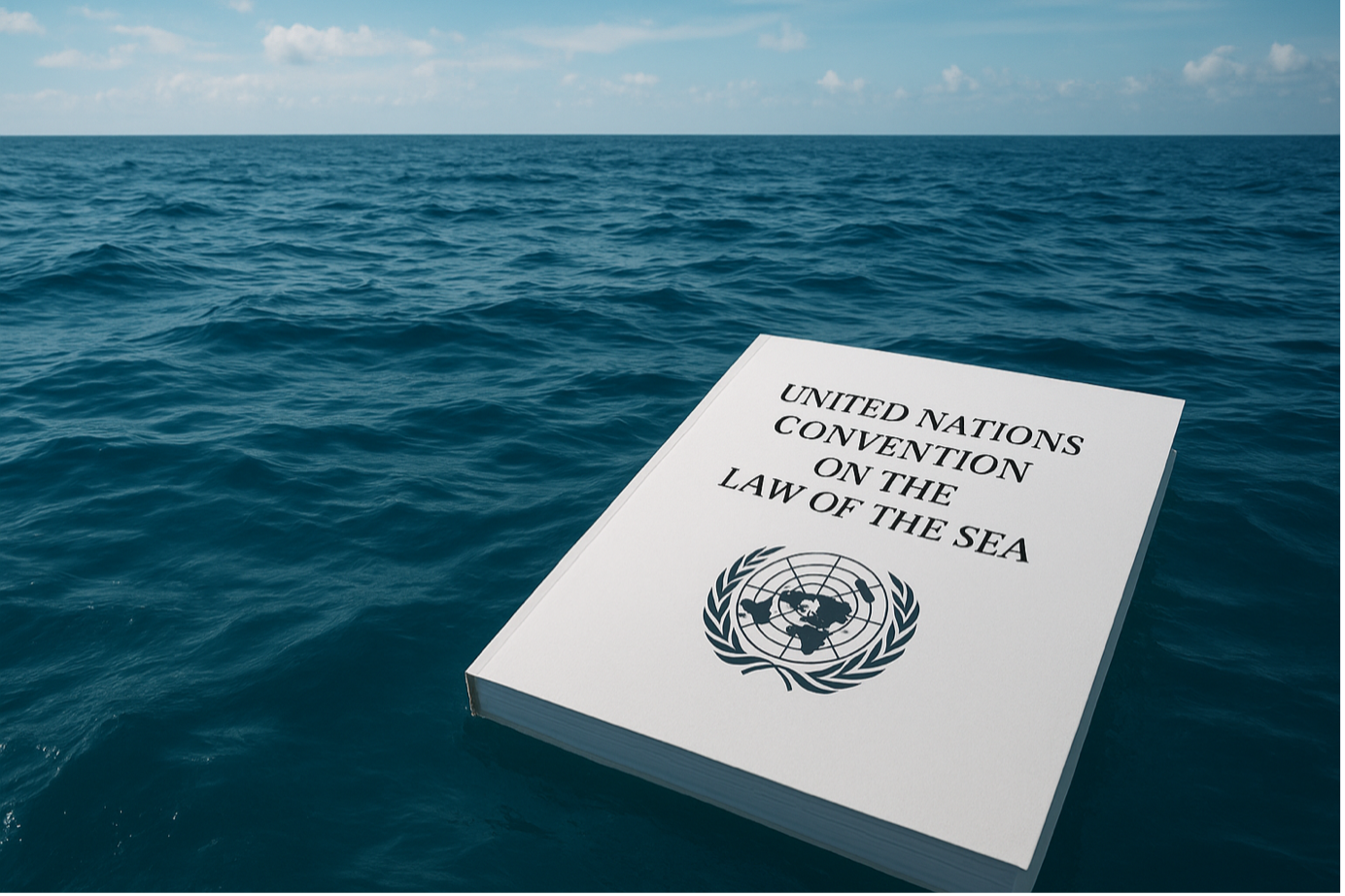
Photo source: AI-generated image created using Chat-gpt 4o, 2025.