On This Day: Agreement between the Royal Government of Cambodia and UN for the establishment of the Extraordinary Criminal Courts of Cambodia – A Product of Compromise (6 June 2003)
This Day in History
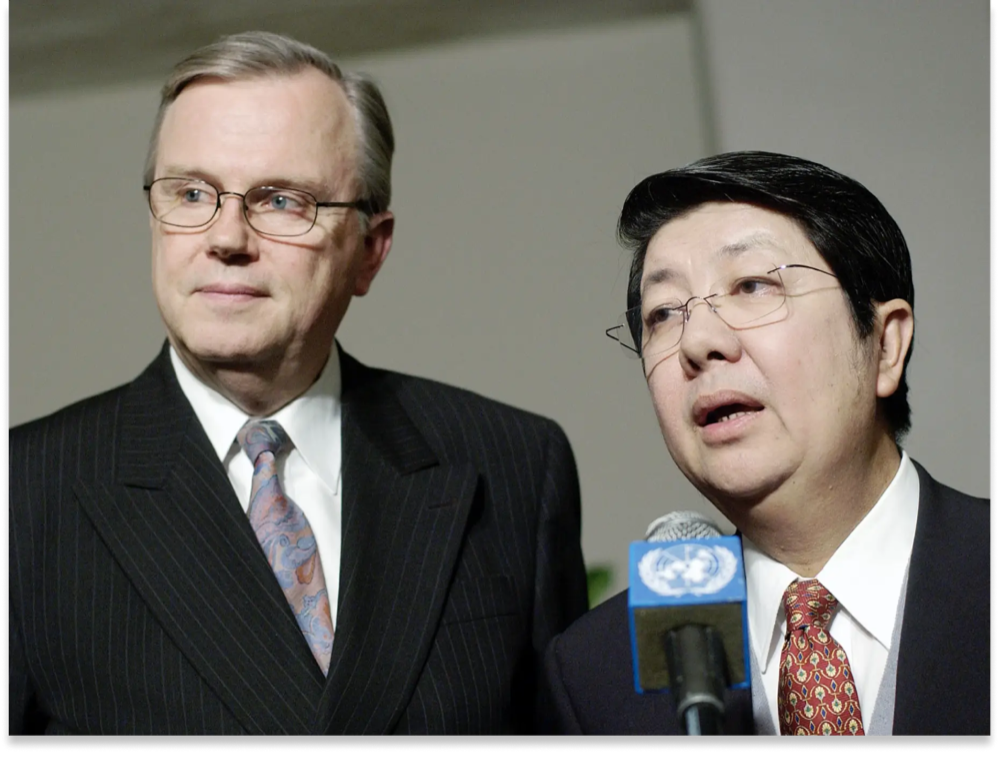
On this day, 6 June 2003, the United Nations and the Royal Government of Cambodia successfully signed an agreement for international assistance in the prosecution of crimes committed during the period of Democratic Kampuchea (“DK”). This agreement marked the birth of the Extraordinary Chambers in the Court of Cambodia (ECCC), a tribunal designed to hold accountable, those responsible for atrocities committed during the Khmer Rouge regime.
This agreement was reached following an often fraught and protracted negotiation. While the UN sought to ensure that international standards of justice were upheld, the Cambodian government insisted that the tribunal must reflect the legal framework of the Cambodian system to maximize accessibility and national ownership. At one point, the tribunal was considered a “lost cause”, with the UN withdrawing from negotiations because a Cambodian court ‘would not guarantee independence, impartiality and objectivity.’ Despite earlier delays, negotiations were eventually renewed, which culminated in a bilateral agreement. This agreement provided the foundation for cooperation and established the tribunal as a Cambodian institution operating with international support.
Thus, a unique creature was born: a ‘hybrid tribunal’ staffed by both Cambodian and international judges, designed to graft international standards onto a national court system.
The aim of the ECCC was articulated by Kofi Annan as judicial accountability, providing the basis of ‘peace, reconciliation and development’ and a ‘central element of any effective remedy for victims’. However, more than two decades and USD $300 million later, the ledger of the tribunal is thin in number, which arguably can be said to be morally significant. Still, the legacy of the tribunal remains the subject of fierce debate.
Historical Context
The Khmer Rouge was a radical communist movement that ruled Cambodia from 1975 to 1979. The regime sought to achieve an agrarian revolution steeped in self-reliance and ideological purity. This resulted in a radical upheaval of Cambodian society, dismantling institutions, displacing city-dwellers to the countryside, and policing thought. In just four years, around 1.7 million Cambodians lost their lives as a result of persecution, famine, overwork or untreated disease. The regime specifically targeted religious and ethnic minorities as well as the educated, where “even crying at a funeral, falling ill or wearing eyeglasses” could lead to execution.
The regime ended on 25 December 1978, when Vietnam invaded Cambodia to establish a communist pro-Vietnamese regime. The Khmer Rouge itself did not disappear until much later and continued to hold Cambodia’s seat at the UN for twelve more years. Most importantly, many survivors continue to feel the lasting effects of the regime that manifest as chronic stress and mental anguish. This has resulted in a shared, multi-generational legacy of trauma, compounded by the subsequent years of political instability.
The Architecture of the Court
By the time the agreement was signed in the 1990s, the Khmer Rouge had been mostly fractured and no longer constituted a meaningful political or military force. Thus, the tribunal’s mandate was retrospective: to adjudicate crimes committed and to establish a public record. The mandate was further restricted to a limited class of offenders: senior leaders of the Khmer Rouge and those deemed most responsible for grave violations of national and international law.
Hybrid Structure
The ECCC was designed as a hybrid institution, staffed by a mix of Cambodian and international judges. The pre-trial and trial chamber consisted of 3 Cambodian and 2 international judges, while the appellate chamber consisted of 4 Cambodian and 3 international judges.
A distinctive structural feature of this hybrid tribunal was the supermajority voting rule. Though each chamber comprised of a simple majority of Cambodian judges, any decision required a ‘simple majority plus one’ to ensure that at least one international judge concurred. This was a unique arrangement amongst internationalized tribunals and was a negotiated compromise intending to balance domestic control with safeguards against political interference.
Victim Participation
An unprecedented and innovative feature of the ECCC was the extent of victim participation in the trial, with more than 3,800 civil parties engaged. The ECCC judicially established a robust “Civil Party” regime, where individuals who suffered physical, psychological or material harm from Khmer Rouge crimes could participate as direct parties to the proceedings seeking “collective and moral reparations”.
This framework afforded civil parties a meaningful role in the judicial process by allowing them to review case files, present legal and factual submissions, pursue certain appeals, participate in hearings, call witnesses, and directly examine the accused.
Importantly, the program also created space for the accused to speak to victims- Duch knelt before victims’ families, acknowledged his guilt, and sought forgiveness. The ECCC later compiled sixteen pages of his apologies. Yet the contribution of such exchanges to reconciliation and closure remains to be seen, as many viewed Duch’s contrition with great scepticism and questioned his sincerity.
In addition, the ECCC undertook extensive public outreach, including free bus services enabling tens of thousands of Cambodians, particularly from rural areas, to observe proceedings directly. This approach promoted civic education and validated community memory. The tribunal’s public attendance reportedly exceeded the combined spectator totals of Nuremberg and Tokyo, the ICTY, the ICTR, the Special Court for Sierra Leone, the Special Tribunal for Lebanon, and the ICC.
Morally Significant Convictions
The ECCC is oft-criticized for their limited number of convictions. The ECCC nevertheless secured convictions of three principal architects of the regime:
(1) Kaing Guek Eav, or ‘Duch,’ who directed S-21, where at least 12,000 detainees were killed. Duch was found guilty of war crimes and crimes against humanity and was sentenced to life imprisonment and died in 2020 serving his sentence.
(2) Nuon Chea, the movement’s second in command, who was closely associated with internal purges and systematic violence. He was sentenced to life imprisonment and died in 2019 serving his sentence.
(3) Khieu Samphan, the head of state of the DK and the regime’s principal public figure. He was found guilty of genocide, crimes against humanity and war crimes. He was sentenced to life imprisonment.
Measured against other international courts, scholar Farr argues that the ECC’s numerically modest record should be considered alongside the seniority of those convicted and the gravity of their crimes. In comparison, the ICC has secured eight convictions over two decades, only three for war crimes and crimes against humanity, on a substantially larger budget.
Criticisms and Constraints
Although the ECCC delivered important legal and symbolic outcomes, a substantial body of scholarly criticism and a series of institutional constraints have significantly counterbalanced these benefits.
Legitimacy Concerns
Cambodia’s decades of conflict encompassed repression under the monarchy, insurgency, extensive US bombing and US-backed military regime, and the instability surrounding Vietnam’s toppling of the Khmer Rouge. This continuum of harm could not be laid solely at the feet of the Khmer Rouge.
Yet the ECCC’s jurisdiction focused narrowly on senior leaders and those most responsible for DK-era crimes. Critics like Killean argue that this selectivity reflected geopolitical preferences. Americans shielded themselves from scrutiny of the bombing campaign during their negotiations, and the creation of the tribunal aligned with contemporary political aims to encourage Khmer Rouge defections and “bury the past.” While UN negotiators reportedly contemplated 20–30 prosecutions, the Royal Government of Cambodia warned that casting a wider net would risk “social unrest”, a claim viewed as questionable given that several ruling figures were themselves former Khmer Rouge cadres.
Structural Flaws
The court’s supermajority voting rule, designed as a safeguard, produced paralysis in practice. Cases 003 and 004 became mired in judicial deadlock when judges could not agree whether the matters fell within jurisdiction, leaving them in legal limbo. Repeated government statements opposing trials beyond Case 002 amplified perceptions of political pressure. In fact, this divergence was stark: international judges issued a detailed, hundred page analysis concluding that Im Chaem should be tried, whereas the national judges issued a brief, two-and-a-half-page reiteration of their opposition to further prosecutions. Splits were often among national/international lines, an outcome that underscored how the court’s design made it acutely vulnerable to stalemate.
Further, the ECCC’s jurisdiction is limited strictly to high-ranking leaders. Consequently, the tribunal was unable to prosecute the vast majority of lower-level perpetrators who directly participated in atrocities, leaving a significant gap in individual criminal accountability. Neither does the ECCC’s framework for accountability confront the complexity of criminal responsibility where perpetrator-victimhood is not dichotomous. In fact, Nou suggests that perpetrators are often plagued by guilt and lack of closure. Importantly, in the quest for a national account, Nou emphasises the shared desire for both families of survivors and perpetrators to create closure.
Victim Participation
Despite the tribunal’s noble aspirations, scholars Mohan and Sathisan contend that the ECCC promised more than it could deliver and that the courtroom was an inherently ill-suited forum for the full expression of victimhood.
Authoritative Record vs. Individual Narrative
The ECCC’s drive to construct a “legally authoritative account” narrowed the space for Civil Parties’ stories. As proceedings advanced, victims’ narratives were instrumentalized toward establishing elements of criminal liability rather than being ends in themselves. Civil parties also lacked parity with the Co-Prosecutors and were slowly stripped of the general right of equal participation as the trial process went on.
Adversarial Filters vs. Legitimising Victimhood
Within an adversarial framework, civil parties’ accounts were contested and sometimes excluded for failing to satisfy evidential or legal thresholds. In Cases 001 and 002, a requirement to demonstrate a direct consequence of at least one charged crime was retrospectively applied, leading to the revocation of 23 applicants’ status in the Case 001 trial judgment. The adversarial framework was considered insensitive and potentially retraumatising.
Therapeutic Forum vs. Procedural Expediency
The tribunal struggled to accommodate nervous or traumatised witnesses recounting events more than three decades old. Requests by counsel for additional time after witness breakdowns met resistance from the bench, emphasising the friction between therapeutic considerations and trial efficacy.
Moving Forward
With the conclusion of trials, the ECCC has pivoted to residual functions, archives, education, outreach, and victim engagement, under increasing Cambodian leadership. This marks a meaningful transition from international justice as an external intervention to a nationally grounded legacy. Unlike many international courts, these functions remain within the original institution and in-country, facilitating sustained engagement with affected communities.
The ECCC’s current work includes high-level victim-survivor workshops, a monthly civil-society forum shaping priorities (access to justice, memorialization, capacity-building, intergenerational storytelling), and a pilot program to designate regional focal persons for direct engagement with civil parties. The Supreme Court Chamber is also declassifying a large corpus of documents, photographs, and audiovisual materials and pairing archival reorganisation with public and school-facing programs to entrench transparency and historical literacy.
Conclusion
The ECCC had great ambitions for its time and implemented many unprecedented initiatives. Yet the very compromises that enabled its creation also constrained its independence and exposed it to political headwinds, with lasting effects on legitimacy and scope. As Mohan aptly summarised the warnings of international commentators, the tribunal indeed became a ‘politicized creature strangled at birth’. Yet it was not rendered entirely lifeless, since the institution endured and produced durable outputs. By contrast, the tribunal’s residual functions have operated with fewer political constraints and thus have been consistently more effective. The tribunal’s legacy should therefore be measured less by the number of convictions and political constraints; and more by its contributions to transitional justice, the maintenance of a public record, and the sustenance of memory and dialogue.
Authors
Celestine Sun Xiyao (NUS law student), Sabri Jasmine Leila (NUS exchange student), and Chan Shao Wei (NUS law student).
Image Credits
https://media.un.org/photo/en/asset/oun7/oun7772317
Note – This article was published late due to the university calendar.