This Day in History
On 14 September 1960, Iran, Iraq, Kuwait, Saudi Arabia and Venezuela signed the Agreement (“the Agreement”) concerning the creation of the Organization of Petroleum Exporting Countries (“OPEC”).
OPEC: Call It an Oil-igopoly
OPEC’s five founding members were later joined by other oil-exporting countries from various continents – including Qatar, Indonesia, the United Arab Emirates (“UAE”), Nigeria, and most recently, Equatorial Guinea and Congo. OPEC membership has fluctuated over time, with countries like Ecuador and Indonesia leaving and re-joining the organisation across the years. The UAE’s recent departure from the organisation leaves OPEC with 11 members. Prior to this, the organisation controlled about 30 percent of the global oil supply, and held 72 percent of the world’s oil reserves.
In 2016, the organisation extended its reach to 11 non-OPEC countries, including Russia, Azerbaijan, Kazakhstan, Brunei and Malaysia. OPEC and non-OPEC countries signed the Vienna Agreement, and agreed to limit oil production to keep oil prices in check. This partnership proved to be successful. The Vienna Agreement was extended, and this coalition was formalised in July 2019 – through the creation of OPEC+. OPEC+ countries agreed – through the Charter of Cooperation – to promote oil market stability, and to collaborate and share information, “for the benefit of oil producers, consumers, investors and the global economy”.
The objectives of OPEC were rudimentary in principle, but complex in implementation. The founding members of OPEC envisaged an organisation, which would ensure (1) “the stabilisation of [oil] prices”; (2) an “efficient economic and regular supply of [oil] to consuming nations” and (3) a “fair return on their capital to those investing in the petroleum industry”. Today, these objectives are enshrined in Article 2 of the OPEC statute.
To understand OPEC’s ambitions – lofty as they were in 1960 – we must revisit OPEC’s story: a story of two highly driven, like-minded, nonconformist mavericks separated across the Atlantic Ocean; a story of the Seven Sisters and the Five Formidables; a story of nationalist and anti-colonial sentiment.
Out with the Seven Sisters, in with the Five Formidables
The pre-OPEC era belonged to the Seven Sisters – a group of Anglo-American multinational oil companies. These companies were the earliest instantiations of oil companies we recognise today – Exxon, Mobil, Chevron, Texaco, Gulf Oil, British Petroleum, and Shell. To capture the eye-watering profits of oil production, the Seven Sisters and Gulf countries shared a symbiotic relationship. The oil companies provided petrostates with the technical capabilities to produce and sell oil, while the petrostates imposed taxes and concession fees on the oil companies.
The symbiotic relationship morphed into a parasitic one. The Gulf countries found themselves beholden to the multinational Anglo-American companies, which had extensive control over oil production rights in Iran, Iraq, Saudi Arabia and other Gulf monarchies.
The Gulf countries realised that there were constraints in collecting tax revenue, royalties and concession fees from oil companies. When a particular government increased taxes beyond a particular oil company’s tolerance, the oil company would simply scale back oil exploration and production, and redirect its resources to another petrostate where the tax burden was lower.
The Gulf countries also realised that they could not control the level of oil production. When a glut of oil proved to be problematic – by depressing oil prices – the Seven Sisters colluded under the 1928 Red Line Agreement, and agreed to not produce oil, unless they had the consent of all parties.
In spite of this, petrostates were still reliant on their arrangements with the Seven Sisters, for political and economic stability. For each individual petrostate, the nationalisation of an Anglo-American oil company was a distant dream; a bureaucratic impossibility. But taken together, an organisation of information-sharing, tax-coordinated, policy-experimenting and price-collaborating petrostates offered an alluring set of promises: the promise of efficient and profitable nationalisation; the promise of “distributive justice” and “a shift toward better terms of trade and economic exchange for the developing world”; the promise of an “economic sequel to decolonization”.
Now, our two highly driven, nonconformist protagonists were ready to make their emphatic entrance. Amidst growing dissatisfaction amongst the petrostates, Juan Pablo Pérez Alfonzo – a Venezuelan medical student turned lawyer and political activist – and Abdullah Tariki – an Aramco critic and Saudi nationalist – soon became acquainted with each other. Together, with a group of transnational elites from the developing world, they advocated for anticolonial causes, including the “right of peoples and nations to permanent sovereignty over their natural wealth and resources” – pursuant to the 1962 UN Resolution on the Permanent Sovereignty over Natural Resources. Fuelled by their nationalist beliefs, Pérez Alfonzo and Tariki endeavoured to tackle the “‘history of petroleum colonization’ that afflicted their countries”.
Slowly, the pieces of the OPEC puzzle began to fall into place. At the Arab Oil Congress, Pérez Alfonzo and Tariki “put enormous pressure on their fellow negotiators to create an international oil organization”. Their deliberations inspired the Maadi Pact – an informal agreement to establish such a unified body.
After the Seven Sisters added fuel to the fire, by humiliating the petrostates and reducing their revenues through a series of oil pricing reductions – designed to compete with cheap Russian oil, support for an international oil organisation surged. OPEC emerged from the flames. The Seven Sisters had enjoyed their time in the limelight. The Five Formidables – Iran, Iraq, Kuwait, Saudi Arabia and Venezuela, representing the signatories to the Agreement – were ready to take their place.
With Great Power Comes Great Profitability … and Great Responsibility
OPEC grew from strength to strength, through the “exchange of technical data and key personnel”, consolidated tax policies and oil pricing strategies, and a wave of nationalisation. In 1972, OPEC signed an agreement with multinational oil companies, giving petrostates a 25 percent participation share in the oil companies. This rose to 51 percent in 1983.
By the 1970s, rapid consumption growth, declining US surplus production capacity, and a changing political climate marked by war and oil embargos shifted market power from the Seven Sisters to OPEC.
Recent history reminds us of OPEC’s tremendous market power. From 2016 to 2017, OPEC limited its oil output for the first time since 2008, driving the price of oil per barrel from US$45 in June 2017 to US$71 in October 2018.
OPEC has also wielded its market power for good, to stabilise oil prices. When the COVID-19 pandemic sent oil prices plummeting to negative levels – with oil trading at -US$37 per barrel, dangerous, large-scale volatility threatened economies, disrupted oil markets, and put millions of oil industry jobs in jeopardy. OPEC+ rallied together, reducing crude oil production by 6 million barrels per day from April 2020 to May 2020, and later by 9.7 million barrels per day from May 2020 to June 2020. This represented the “largest monthly production decline since 1993”. Cuts in oil production, and recovering demand, revived oil prices to US$51 per barrel by the end of the year. When the world began to move on from the pandemic, and oil prices climbed to US$80 per barrel in 2021, OPEC+ stepped in and cautiously increased oil production by 400,000 barrels per day.
OPEC: No Longer the Well-Oiled Machine It Once Was?
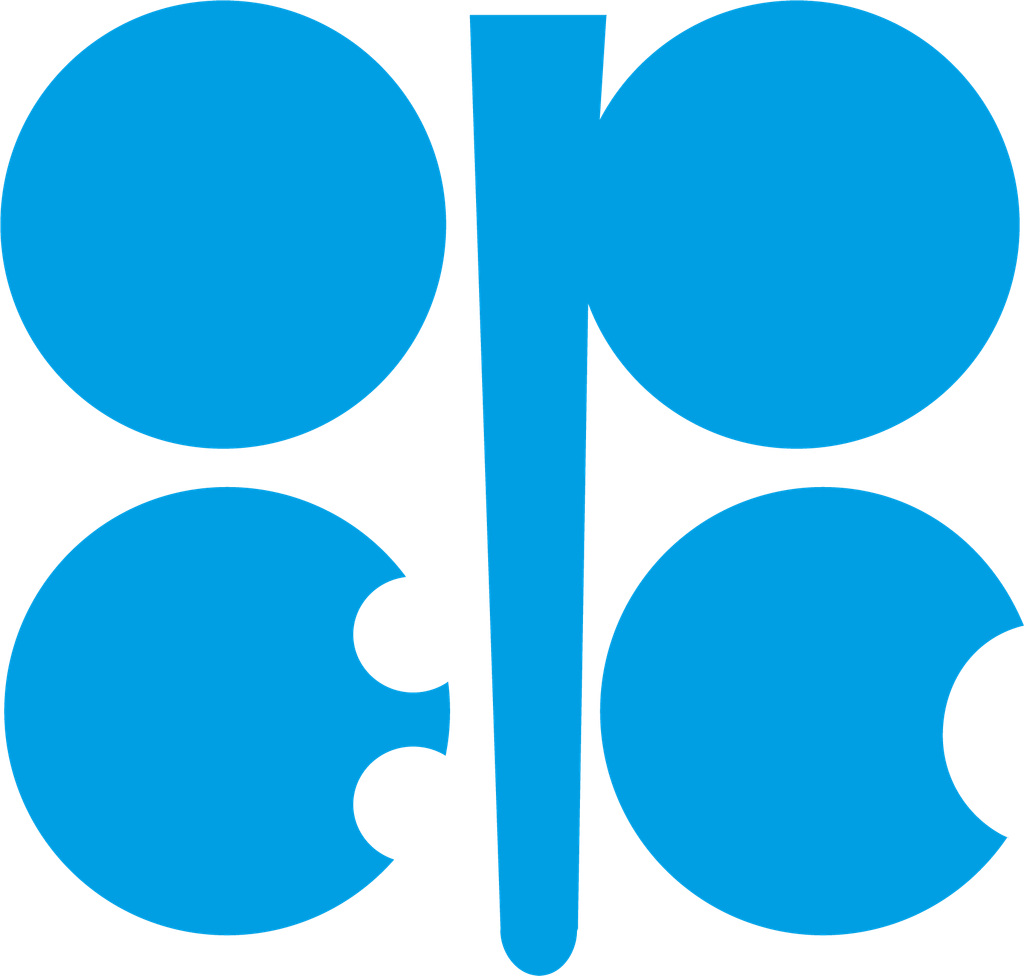
Image source: OPEC International Seminar Media Kit
Gertrude Svoboda had been designing stamps for the Austrian Ministry of Foreign Affairs, when she was invited to try her hand at designing the OPEC logo in 1969. Svoboda wanted a recognisable and transferable design. Her winning submission reduced the four letters of OPEC into a simple geometric emblem – four rounded circles, with a slender central stroke adjoining the upper-right circle to form the letter “P”, and carefully placed cut-outs transforming the latter two circles into the letters “E” and C”.
Viewed through a more cynical lens, Svoboda’s four circles – progressively punctured by larger semicircular cut-outs – seemed to prophesy the four cycles of OPEC’s changing membership, unfolding anticlockwise.
In fact, OPEC’s members have often resembled oil and water in their policy positions, and the organisation recently witnessed the departure of Qatar in 2019, Angola in 2024, and the UAE this year. Qatar left OPEC to concentrate on liquefied natural gas exports, while Angola withdrew from the organisation after a spat over output production quotas.
The UAE’s departure is the biggest test of OPEC’s modern relevance, because the UAE is the first founding member to leave OPEC, the organisation’s third-largest producer, and a consistently “strong backer of [OPEC] quotas”. Experts believe that the UAE’s departure was triggered by (1) a desire to capitalise on investments in production capacity; (2) a “revenue maximization” strategy – where a producer captures market share through volume rather than high, artificially set prices; and (3) differences in foreign policy and bilateral relations – such as with Israel and the United States.
Will the UAE’s departure prove to be too difficult for OPEC? OPEC sceptics believe it could be the final nail in the coffin for the cartel. In the UAE’s absence, Saudi Arabia – OPEC’s largest producer and exporter – will now face the herculean task of “[doing] most of the heavy lifting regarding internal compliance and market management” within OPEC. The Iran war has certainly not helped, and the closure of the Strait of Hormuz has choked oil exports for several OPEC members, with Iran, Iraq and Kuwait being hit the hardest . The crisis has threatened to precipitate the departure of high-profile members like Iraq who will be keen to dramatically ramp up production, in opposition to members like Saudi Arabia who have been able to export oil via the Red Sea, and who would prefer to set lower production quotas to keep oil prices in check. While Iraq’s oil ministry has explained that it “currently has no intention of withdrawing” from OPEC, a ministry spokesperson has warned that it would have to reconsider its position, if OPEC does not raise Iraq’s production quotas to acceptable levels.
Only time will tell if the organisation – which has struggled with a “lack of quota-discipline”, internal divisions, and recent crises such as the aftershocks of the Iran war – will weather the years ahead. Some experts are more sanguine about OPEC’s enduringness. As one commentator humorously put it, “reports of OPEC’s death have been greatly exaggerated”. The organisation has expanded its alliances through OPEC+, is still home to the largest exporter of crude oil (Saudi Arabia), and for over 65 years, has “survived wars, sanctions, member exits, price crashes … and the emergence of alternatives and renewable energy”.
For now, all there is left to do is to revel in the extraordinary ambition of Pérez Alfonzo and Tariki, the remarkable turbulence of OPEC’s history, and the audacity of the experiment in global power that they set in motion.
About the Author
Benjamin Kok is a 3rd year LL.B. (Hons.) student at the National University of Singapore.
Image Credit
C.Stadler on Wikimedia Commons