Declaration on Principles of International Law concerning Friendly Relations and Co-operation among States in accordance with the Charter of the United Nations
This Day in History
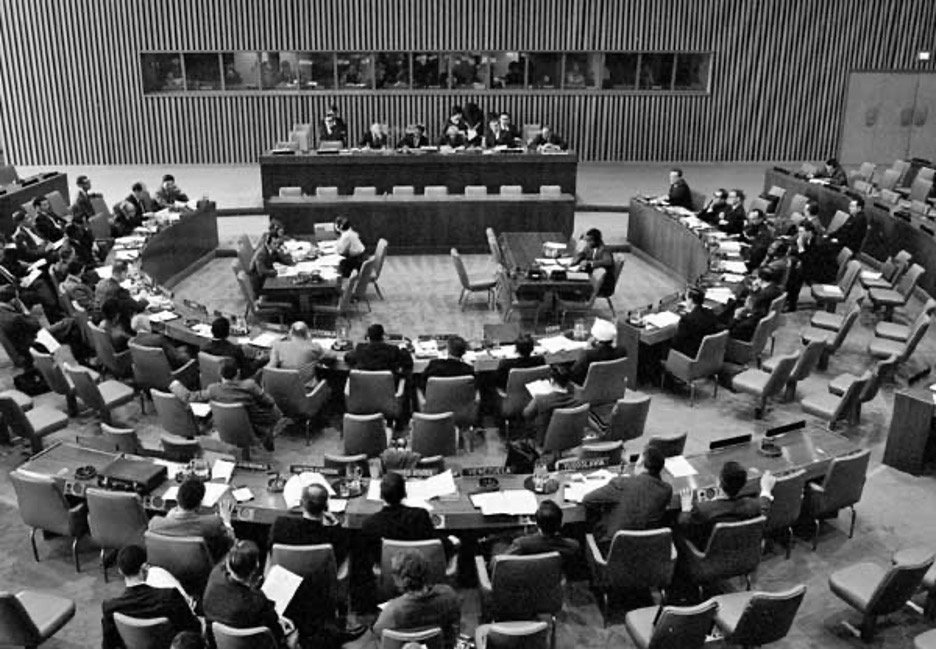
The ink of decolonisation was still wet across much of Asia when, in New York, the United Nations sought to define how states should coexist in a divided world. On 24 October 1970,the General Assembly adopted Resolution 2625 (XXV), without a vote, approving the Declaration on Principles of International Law concerning Friendly Relations and Co-operation among States in accordance with the Charter of the United Nations (“the Declaration”).
The Declaration elaborated seven principles, including the prohibition of force; peaceful settlement of disputes; non-intervention; self-determination; and the sovereign equality of states. Although merely a declaration, its language has repeatedly been relied upon by the International Court of Justice as evidence of customary international law, from Nicaragua (1986), to Kosovo(2010) and most recently, Palestine (2024).
Resolution 2625 has a distinctly Asian history. Ideas of sovereign equality, non-interference and peaceful coexistence had already been articulated by states like India, China and Indonesia. Asian states later helped carry these ideas into the UN negotiations. In the years that followed, the region became an early arena in which the Declaration’s competing principles were tested against one another. More than half a century later, Asian states continue to invoke those same principles in regional diplomacy, international litigation and debates over sovereignty and self-determination. Its Asian history is therefore one of contribution, contestation and endurance.
Part II: Contribution
Asian contributions to the Declaration began well before 1970. Many of the principles eventually embodied in Resolution 2625 had already been circulating through Asian and Afro-Asian diplomacy. In a 1961 Sixth Committee intervention, Nepal’s representative traced the concept of “peaceful coexistence” to the Five Principles of Peaceful Coexistence, or Panchsheel, articulated in the 1954 Sino-Indian Agreement: respect for territorial sovereignty; non-aggression; non-interference; equality; and peaceful coexistence. He then described the subsequent 1955 Bandung Conference, which brought together 29 Asian and African states at a moment when colonialism was receding, as their “most potent” expression. In 1970, Ceylon’s representative made this connection explicit, describing the Bandung Principles as “practically identical in substance” to the Declaration draft then before the Committee.
This genealogy shows that ideas later presented as universal principles of international law had already been articulated in Asia. Beyond forming part of the intellectual terrain on which the Declaration was established, Asian states were also active participants in its creation. By the final Sixth Committee debate, delegates from across Asia — including Afghanistan, Cambodia, Ceylon, China, India, Indonesia and Japan — had put forward their opinions, and many were among the 64 co-sponsors of the final draft. Thus, beyond merely supplying ideas from the margins, Asian states were also present in the institutional process through which those ideas were recast as international law.
Their involvement was hardly surprising at a time when decolonisation had transformed the international community. For newly independent states, sovereignty was more than an abstract doctrinal concept: it was a necessary legal expression of hard-won independence. As Nepal’s representative argued, existing international law had to be “reformulated and revitalized” for this new world. Sovereignty thus functioned as a shield, promising that stronger states could not simply dictate political choices, redraw borders or reduce formal independence to dependency.
This helps explain why principles such as non-intervention and territorial integrity carried particular weight in Asia. Yet, the very Declaration that fortified the new state also protected the self-determination of peoples, giving rise to a tension that would soon become impossible to ignore.
Part III: Contestation
The Declaration contained an uneasy bargain as it sought to protect states and peoples at once. Its stabilising side defended sovereignty and freedom from foreign intervention; its liberating side affirmed the right of peoples to self-determination. For peoples under colonial or foreign domination, this right could be emancipatory. For newly independent states, however, an unlimited version of the same principle could mean fragmentation. The Declaration therefore solved one problem while introducing another: if a people demanded independence, when did self-determination justify separation, and when did the territorial integrity of the existing state prevail?
Asia confronted this tension almost immediately.
In Bangladesh in 1971, barely a year after the Declaration was adopted, the crisis in East Pakistan placed Pakistan’s territorial integrity against Bengali claims to self-determination, while India’s intervention raised questions of self-defence and non-intervention. On 7 December, the General Assembly adopted Resolution 2793 (XXVI), by 104 votes to 11, with 10 abstentions, calling for a ceasefire and withdrawal of armed forces. While the Declaration could identify the values in conflict, it could not determine which should prevail.
Four years later, a sharper irony emerged in East Timor in 1975. Indonesia had hosted the Bandung Conference two decades earlier and had been one of the most prominent voices of anti-colonial internationalism. Yet, following its intervention in East Timor, Security Council Resolution 384 deplored the intervention, reaffirmed the East Timorese people’s right to self-determination and called for Indonesia’s withdrawal. Principles once championed by postcolonial states were now turned back upon them. In one sense, this reflected the success of the Declaration: once the principles became international law, the states that helped promote them lost the ability to control against whom they would be used.
The clearest example came in Cambodia in 1978–79. Vietnam expressly relied upon the Declaration in justifying its invasion. Before the General Assembly, its representative characterised the National United Front for the Salvation of Kampuchea as a liberation movement resisting the Pol Pot regime. He invoked Resolution 2625 permitting peoples who were resisting forcible denial of self-determination to seek and receive support. He then argued that this justified assistance to the Kampuchean movement, including, on his reading, armed assistance. ASEAN states, including Singapore, rejected this reading, emphasising non-intervention, sovereignty and territorial integrity. Later, General Assembly resolutions called for the withdrawal of foreign forces while reaffirming Cambodia’s independence and right to self-determination.
The opposing sides were reaching into different parts of the same Declaration. One side foregrounded self-determination, assistance and self-defence, while another foregrounded sovereignty and territorial integrity. Both claimed fidelity to foundational principles yet arrived at opposing positions.
Part IV: The Declaration’s Afterlife in Asia
Though these conflicts exposed the tensions within the Declaration, its subsequent development and evolution e is a testament to its durability, especially in the Asian context. Its core vocabulary was gradually absorbed into Asia’s regional institutions and continues to surface in contemporary diplomacy and international litigation.
In Southeast Asia, the 1976 Treaty of Amity and Cooperation (TAC) entrenched a strikingly familiar cluster of principles: sovereignty, non-interference, peaceful settlement, renunciation of force, and cooperation. These principles come from the same genealogy as the UN Charter and the Ten Principles of Bandung. ASEAN later reaffirmed similar principles in the 1976 ASEAN Concord and 2005 Kuala Lumpur Declaration.
Elsewhere in Asia, individual states continue to draw different lessons from Resolution 2625. Japan places it within its contemporary “rule of law among nations” diplomacy, particularly the opposition to territorial change through force. China, by contrast, has invoked another part of the same Declaration. In its 2023 written statement before the ICJ, China argued that international law recognises no general right of “remedial secession”. That position illustrates how the old tension between self-determination and territorial integrity remains alive more than fifty years after the Declaration was adopted.
The Declaration also continues to appear in Asian states’ submissions before international courts. In the recent ICJ proceedings concerning the Occupied Palestinian Territory, Pakistan, Kuwait, Jordan and the United Arab Emirates all relied on principles central to Resolution 2625, including self-determination and the prohibition on acquisition of territory by force.
Part V: Conclusion
In closing, the Declaration was born in a world still shaking off empires. Though Asian states helped bring such principles they regarded as essential to protecting their newly won independence into international law; within years, those very principles were invoked both by and against them. That is precisely why Resolution 2625 should not be treated as a relic of decolonisation. More than five decades after its adoption, the ink of decolonisation may have dried, but the questions it launched onto the international legal order—who may rule, who may resist, and how far sovereignty protects —remain very much alive.
About the author
Sarah Shah is a NUS Law graduate.
Image Source: https://legal.un.org/avl/ha/dpilfrcscun/dpilfrcscun.html