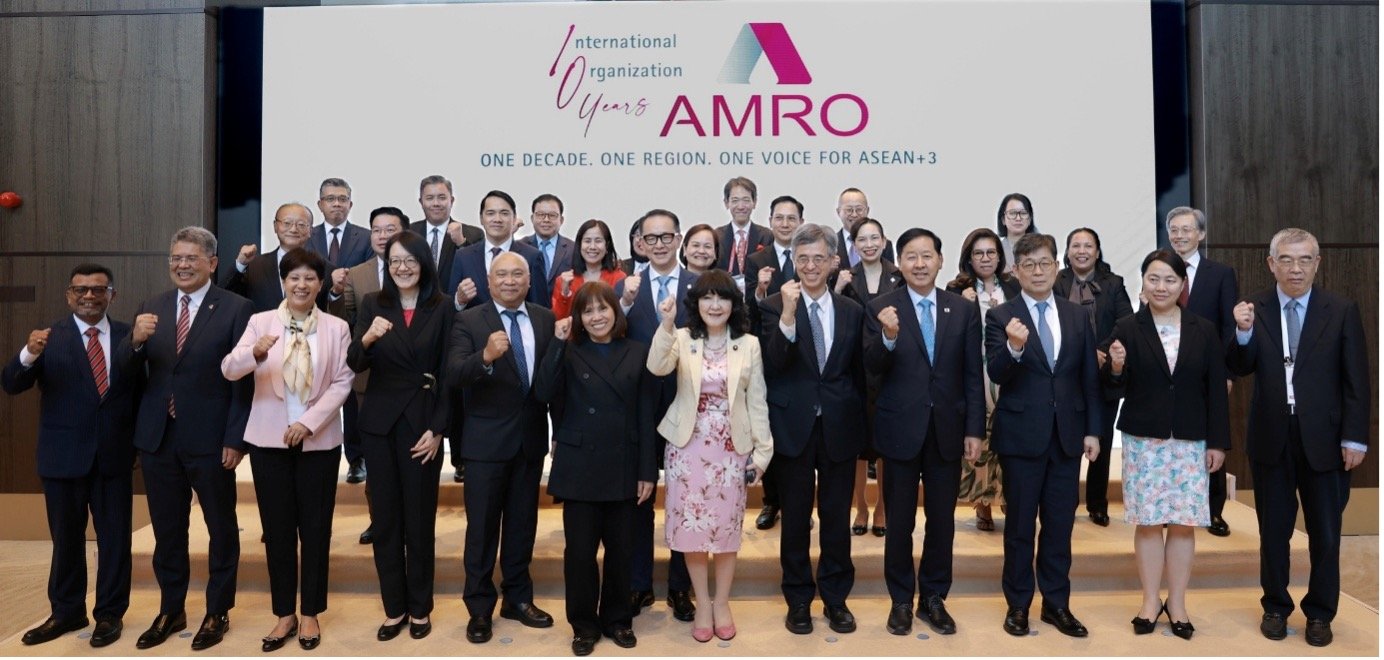
This Day in History
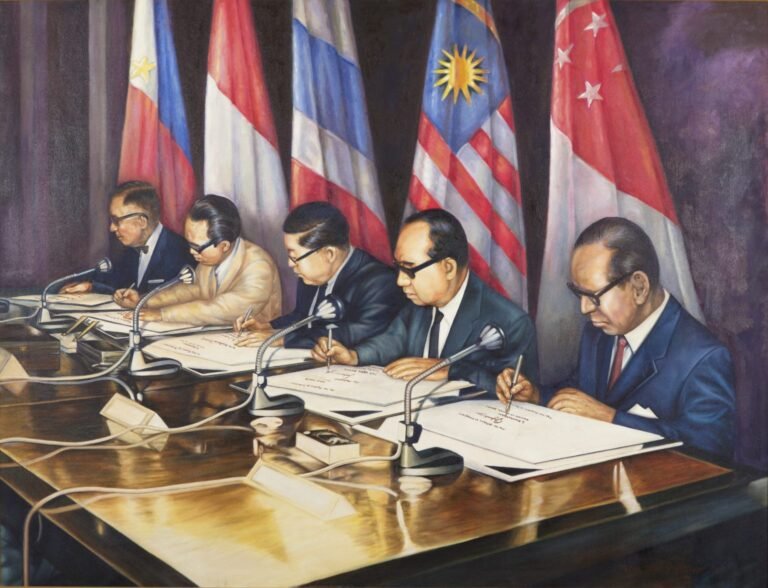
On October 10, 2014, on the sidelines of the IMF/World Bank Annual Meetings in Washington, D.C., representatives of the 14 ASEAN+3 member economies signed the Agreement Establishing the ASEAN+3 Macroeconomic Research Office (“AMRO Agreement”). This October marks 12 years since that signing ceremony, and 2026 marks a decade since the treaty entered into force on February 9, 2016.
Upon entry into force, the treaty transformed AMRO from a company limited by guarantee (“AMRO Limited”) incorporated under Singapore law into a treaty-based international organization with independent legal personality and a dual purpose: contributing to securing the region’s economic and financial stability through regional economic surveillance, and supporting the implementation of the regional financing arrangement.
A decade on, tracing AMRO’s legal journey reveals a pragmatic approach to multilateral institution-building in Asia – and illustrates its continuing significance for the region’s financial architecture.
Out of the Ashes of 1997
AMRO’s origins can be traced back to the Asian Financial Crisis of 1997–1998. The crisis accelerated efforts among ASEAN, China, Japan, and Korea to build stronger regional mechanisms for financial cooperation. In 2000, the Chiang Mai Initiative emerged as a network of bilateral currency swap arrangements. By 2010, members multilateralised and consolidated these arrangements through the Chiang Mai Initiative Multilateralisation (“CMIM”), creating a single arrangement with USD 120 billion in resources. This was doubled to USD 240 billion in 2014, under which members can draw liquidity support in a crisis.
However, the CMIM required more than financial resources. It also required credible surveillance, the capacity to assess vulnerabilities before a crisis occurs, and mechanisms to support decision-making when financing is needed.
Against this background, in February 2009, ASEAN+3 Finance Ministers agreed to establish an independent regional surveillance unit. They wanted the unit up and running quickly. Yet drafting, negotiating and ratifying an international treaty-based organization could take years. Thus, the region adopted a pragmatic approach: in April 2011, AMRO Limited was incorporated in Singapore as a company limited by guarantee under the Singapore Companies Act.
The Limits of a Company
Incorporation allowed AMRO Limited to start operations promptly, but this form presented limitations.
As a Singapore company, AMRO Limited was subject to Singapore’s employment and immigration regulations, which constrained recruitment across the region. It also did not enjoy the customary privileges and immunities generally accorded to international organizations, including immunity from legal process and the inviolability of archives, which are critical for independent operations. More fundamentally, effective surveillance depends on access to timely and often confidential economic information. The sharing of such information posed challenges for a recipient entity governed by the domestic law of a single member state.
Accordingly, soon after AMRO Limited began operating, the ASEAN+3 Finance Ministers instructed their deputies to study options for strengthening its legal status and constituting it as an international organization.
Drafting the Treaty, Signing and Entry into Force
Drafting began in earnest after May 2012, co-led by AMRO Limited and the Singapore authorities as host country. Agreement required consensus among all 14 member economies. That consensus was reached in 2013, with two design choices standing out.
First, the drafters adopted a deliberate two-tier architecture. Only fundamental matters were placed in the treaty, while operational details were left to secondary rules that members could amend without reopening the treaty. Amending the treaty would generally require members to undergo domestic processes for ratification – a potentially lengthy process. The resulting treaty was roughly one-third the length of the Articles of Association of AMRO Limited, designed to accommodate institutional evolution.
Second, the AMRO Agreement equipped AMRO with the customary features of an international organization. Article 17 confers on the organization legal personality and capacity to contract, acquire and dispose of property, and institute legal proceedings. Article 18 provides AMRO with immunity from legal process and inviolability of archives, while Article 19 provides functional immunity for its personnel. Article 11 requires the Director and staff to “owe their duty entirely to AMRO” and obliges members to refrain from attempting to influence them, while Article 4 requires members to cooperate “in good faith” and provide information reasonably required for surveillance. For an organization tasked with delivering candid economic assessments of its own member economies, these safeguards are integral to the effective discharge of its mandate.
Although the AMRO Agreement was signed on October 10, 2014, entry into force was contingent on completion of the required domestic procedures by member economies. Under Article 26, the treaty would enter into force sixty days after the deposit of instruments of ratification, acceptance or approval by China, Japan, Korea and at least five ASEAN member states including Singapore.
Ratification took another sixteen months, and the AMRO Agreement officially entered into force on February 9, 2016. AMRO Limited was formally dissolved in December 2019.
AMRO and the ASEAN+3 Way
AMRO’s creation reflects a broader feature of regional cooperation, sometimes described as the ASEAN way: institution building through gradualism, consultation and consensus, rather than through a single constitutional leap. The Chiang Mai Initiative began in 2000 as a network of bilateral swap arrangements, was transformed into a single multilateral arrangement in 2010, doubled in size in 2014, and, along the way, an independent surveillance unit was established as a company and later upgraded to a treaty-based international organization. No single step fundamentally overhauled the existing structure. Cumulatively, however, these changes gave rise to an architecture that did not exist a generation ago.
This philosophy is reflected in AMRO’s governance. Every member is represented on the Executive Committee – which is constituted under Article 7 of the AMRO Agreement. Article 9(2) of the AMRO Agreement provides that decisions of the Executive Committee shall be taken by consensus. At the same time, Article 9(2) combines that preference for consensus with an important safeguard against institutional paralysis: if consensus cannot be reached, the Executive Committee’s decisions become effective when approved by no less than two-thirds of the total voting power.
Pursuant to Article 9(1), and the Schedule in the AMRO Agreement, voting power reflects financial commitments while ensuring every member retains representation and basic votes. No single member has a formal veto over ordinary decisions. This contrasts with governance arrangements in some multilateral institutions where voting thresholds, combined with a particular member’s voting share, can give that member effective blocking position over specific decisions requiring a supermajority.
Amendments to the AMRO Agreement occupy a different category. Because they alter the constitutive treaty itself, Article 22 requires consensus in the Executive Committee and subsequent ratification, acceptance or approval by all members.
The relationship between AMRO and the CMIM makes this architecture even more distinctive. AMRO is a treaty-based international organization. The CMIM, by contrast, is governed through a separate multilateral contractual agreement among participating authorities, under which members commit resources for possible currency swap transactions. One part of the regional financial safety net is supported by a treaty creating an international organization, while another continues to operate through contractual commitments and coordinated action by national authorities.
This combination of gradualism, consensus seeking, inclusive representation and pragmatic flexibility helps explain the particular path of ASEAN+3 financial cooperation. The regional architecture has not been built by transferring large areas of authority at once to a central institution. Instead, members have added institutions, rules and capabilities progressively, with each layer building on what came before. The result is a regional architecture shaped by collective ownership. Its development may be incremental, but each advancement is underpinned by broad agreement among members.
Why the Legal Form Mattered – and Still Does
Did the change in legal form matter in practice? It certainly did.
AMRO Limited, constrained by a publication policy requiring unanimous approval, had only a modest publication footprint. The treaty organization is different. AMRO expanded its surveillance output, built formal relationships with institutions such as the IMF, the Asian Development Bank and the European Stability Mechanism, and obtained Permanent Observer status at the United Nations General Assembly in 2017. The shift from company to international organization was therefore not merely formal. It gave AMRO greater scope to conduct surveillance, to engage with peer institutions and to strengthen its international standing.
Two aspects make AMRO’s journey particularly relevant from an international law perspective. First, AMRO inverted the typical sequence of institution-building. Rather than establishing a treaty-based organization from the outset – as in the IMF and World Bank model – ASEAN+3 used domestic corporate law as a temporary vehicle for AMRO’s eventual transformation into an international organization. This “function first, form later” approach reflects a pragmatic way of institution-building, and AMRO provides a useful example of how incremental and consensus-driven regional cooperation can achieve important results.
The second aspect is forward-looking. ASEAN+3 members are once again considering questions of institutional design, as they continue discussions on transitioning the CMIM to include a paid-in capital structure, which would further complement the Global Financial Safety Net.
These discussions inevitably have a legal dimension, including the appropriate framework to hold and manage such financial resources, what legal powers are required, how lending and surveillance functions interact, and what governance and accountability arrangements should accompany them.
As these discussions progress, ASEAN+3 may once again need to rely on its treaty-making machinery, including signature, ratification, and entry into force. Any such process would be informed by the region’s tradition of advancing through carefully negotiated and incremental steps, with new legal arrangements building upon institutions and practices that came before.
Therefore, October 10 provides an occasion to reflect on the signing of the AMRO Agreement in 2014 and its broader significance. It is a precedent that illustrates how Asia can use international law creatively, adapting established legal forms to the particular needs of regional cooperation.
About the Author
Gustavo Pinto is a Senior Legal Advisor at AMRO, advising on governance, surveillance, CMIM financing arrangements, and efforts to strengthen the regional financial safety net.
Image Credit