This Day in History
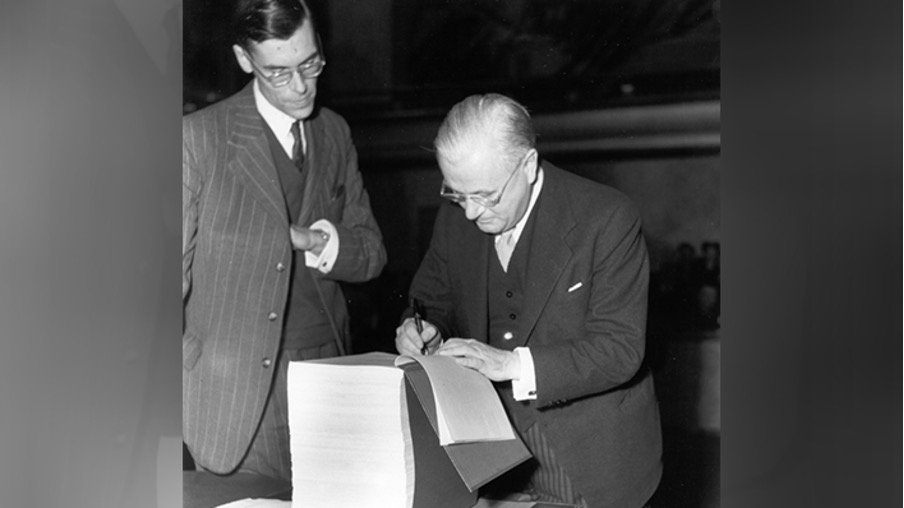
On 30 October 1947, the General Agreement on Tariffs and Trade (GATT 1947) was adopted. It subsequently became effective in January 1948 via a Protocol of Provisional Application. Following the failure to establish the International Trade Organization (ITO), the GATT 1947 became the de facto instrument governing international trade. It was provisionally applied for 47 years until its incorporation by reference into the 1994 Marrakesh Agreement Establishing the World Trade Organization (WTO Agreement). Accordingly, this post examines the origins and core principles of the GATT 1947, alongside some Asian states’ contribution to its creation.
The GATT 1947’s Background and Scope
After the disastrous political and economic catastrophes that took place in the 1920s and 1930s, the United States (US) led efforts to rebuild the international economic order. A defining milestone was the 1944 Bretton Woods Conference, which primarily established the International Monetary Fund and the International Bank for Reconstruction and Development (now World Bank). Regarding trade, however, the Bretton Woods Conference simply recommended that participating governments should aim to reduce trade obstacles. Thereafter, the US and its allies tried, but failed, to produce a deal on commercial policy.
In February 1946, the US introduced a proposal in the inaugural session of the United Nations (UN) Economic and Social Council, which led to the organisation of the UN Conference on Trade and Employment (UN Conference) to establish an international trade organization and create new trade rules. A series of Preparatory Committee meetings in London, New York and Geneva preceded the final session for the UN Conference in Havana. The initial text of the GATT 1947 drew directly from the commercial policy chapter found in an earlier version of the Havana Charter for an International Trade Organization (Charter), which was shaped by the debates in the first preparatory session for the UN Conference in London (October-November 1946) and later linguistically improved upon by Drafting Committee meetings in New York (January-February 1947). Additionally, plans were made for the GATT to be a separate provisional arrangement in London. At the Geneva session (April-October 1947), the GATT and draft Charter negotiations proceeded in parallel. The GATT negotiations focused primarily on tariff negotiations, and subsequent changes to the initial text of the GATT 1947 were relatively minor. At the end of the Geneva session, the GATT 1947 was adopted.
Asia’s Participation in the Shaping of GATT 1947
The documents from the London preparatory session are useful because they offer key insights into how Asian delegations contributed to shaping an earlier draft of the Charter, which the GATT later drew from. Asia was generally underrepresented in the negotiations of the GATT 1947 and the Charter because several Asian countries were still under colonial rule. Only seven out of the 23 original GATT 1947 contracting parties were from Asia (Burma, Ceylon, India, Pakistan, the Republic of China, Lebanon and Syria). Nevertheless, some Asian countries leveraged their presence to champion key issues, particularly the difficulties for undeveloped countries to liberalise trade. Using India and the Republic of China as examples, this post examines some highlights of their engagement.
India
Although India was not independent when the UN Conference negotiations began, the British-administered government was treated independently. The Indian delegation engaged with these negotiations from the outset, offering detailed comments on the 1945 US Proposals for Expansion of World Trade and Employment. These proposals later formed the basis of the 1946 Suggested Charter for an International Trade Organization of the United Nations (Suggested Charter), which guided initial Preparatory Committee discussions in London.
A notable contribution of the Indian Delegation was their advocacy for developing countries’ interests in the negotiations. For example, in their initial comments on the US’ proposals, India opined that the US and the United Kingdom’s efforts to reduce global trade barriers – to access raw materials and markets – insufficiently accounted for the needs of undeveloped economies.
Similarly, in a sub-committee meeting during the London preparatory session in 1946, the Indian delegation highlighted how “it [was] not fair to expect the undeveloped countries to accept readily and without qualification” substantially reduced tariffs as it could harm their infant industries. In another meeting, the Indian delegation expressed concern on how developing economies may not be as able to grant tariff cuts equivalent to that of their developed counterparts. India also highlighted the weaker bargaining power developing countries wielded vis-à-vis developed economies in tariff concessions negotiations.
Notably, India continues to advocate for the interests of developing countries at the WTO (e.g. here and here), although its actions have occasionally drawn criticism. For example, India has consistently blocked the incorporation of plurilateral initiatives, such as the incorporation of the Investment Facilitation for Development Agreement into Annex 4 of the WTO Agreement (see here and here).
China
The Republic of China actively engaged in the UN Conference negotiations. For example, during the London preparatory session, the Chinese delegation shared that although they were open to reducing import tariffs on certain goods for their industrialisation efforts, an “adequate measure of tariff protection” had to be given to “various agricultural products and certain types of infant industry that are vital to her national economy”. The delegation also proposed a “Transitional Period of Industrial Development”, which would allow qualifying parties to “impose a reasonable measure of protective tariff, to be gradually reduced with the advancement of industrialisation”. This proposal for a transitional period was again raised in another communication where the Chinese delegation opined that the regulation of Quantitative Restrictions (QRs) should not prevent China from pursuing industrialisation and other “interests of an economically under-developed country”.
Furthermore, the Republic of China had in principle no objections to unconditional most-favoured-nation (MFN) treatment, stating that it was the “traditional policy of China to accord unconditionally the most-favoured-nation treatment to its treaty nations”. Nonetheless, during the early stages of negotiations, the Chinese delegation reserved its right to adopt unconditional MFN, arguing that not all of the negotiating participants were ready to “give up without compensation their preferences” and/or their support for regional preferences. The Chinese delegation also wanted to assess how MFN would affect their economic growth and future trade relations with other countries.
Notably, after the People’s Republic of China was established in 1949, the Republic of China withdrew from the GATT 1947 in May 1950.
The GATT 1947 and Development
Although the US’ initial Proposals and Suggested Charter did not address developing economies’ concerns, Article XVIII of the GATT 1947 acknowledged that governmental assistance in the form of protective measures might be needed for economic development. These provisions first appeared in the London draft of the GATT. While these provisions were imperfect and amended later, their incorporation demonstrates that advocacy and engagement in the UN Conference negotiations by developing nations, which at that time included India and the Republic of China, yielded tangible results. Developing countries subsequently maintained pressure on the more developed economies to address their interests in the Charter, resulting in an instrument that the US felt no longer adequately represented American interests.
Most-Favoured-Nation Treatment, National Treatment and Rules on Quantitative Restrictions
The GATT 1947 aimed to substantially reduce tariffs and other trade barriers on a reciprocal and mutually advantageous basis through three foundational pillars: (1) the MFN principle (Article I:1), which prohibits trade discrimination between foreign trading partners; (2) the national treatment principle (Article III), which prohibits internal taxes and regulation that discriminate against imported products; and (3) the general prohibition on QRs (Article XI:1), which bans measures that limit the quantity of a product that may be imported or exported.
Existing Pressures on MFN
The inclusion of the MFN principle was championed by the US in the GATT 1947 negotiations. The MFN principle helped to drive significant post-war trade growth, where the initial GATT 1947 schedules resulted in 45,000 tariff concessions affecting $10 billion in trade. However, the US has alleged that abuses of the MFN principle by non-market economies undermine reciprocity and fairness. Accordingly, the US maintains that the MFN principle needs to be reconsidered. This shift in attitude is evidenced from the unprecedented application of “Liberation Day” tariffs in April 2025, which resultedin a universal 10% tariff being applied on all imported goods. Subsequent adjustments to tariff rates have varied by country and justification, marking a tumultuous year for trade.
The US has also flagged the MFN principle as an issue in the WTO General Council. For instance, in a December 2025 communication, the US described the MFN principle as “unsuitable for this era”. In another July 2026 communication, the US stated that the MFN principle “fails to promote reciprocity and balance within today’s trading system.” At the G20 Trade Ministerial in Milwaukee, which was held recently in October 2026 under the US’ Presidency, G20 Trade Ministers also debated on reforms for the MFN principle. Notably, the MFN principle also faces pressure from the European Union, as evident from their submissions to the General Council in January 2026 and in July 2026.
Conversely, several WTO Members, including Pakistan, Republic of Korea and Singapore, reportedly questioned the US’ proposal to abandon the unconditional MFN principle. The MFN principle is vital for trade-dependent countries like Singapore, as it levels the playing field between big and small economies, providing access to overseas markets, and accordingly, economic opportunities. China also opined in a February 2026 communication that “[t]he MFN principle shall remain the bedrock of the WTO”. In a September 2026 communication, China warned that “[m]aking MFN treatment conditional signals a return to power-based trade relations in the name of reciprocity”. In a press release on the 2026 G20 Trade Ministerial, China further emphasised that the MFN principle “is the cornerstone of the multilateral trading system, providing stability and predictability for global trade”.
Only time will tell whether the MFN principle will evolve conceptually. Despite intense pressure, 72% of global trade continues to be on an MFN basis.
Conclusion
Notwithstanding the US’ leadership in shaping the post-war international economic order, several Asian states were able to contribute to the establishment of a rules-based trading system. Looking ahead, the Asian experience during the GATT 1947 negotiations demonstrates the enduring importance of multilateral engagement in shaping the world order.
About the Author
Teo Jian Ling is a Research Associate at the NUS Centre for International Law.
Image Credit